Methods · three notes

How a surface becomes a file.

Studio notes, not a paper dump. The same path the lab walks before a drop sits on the shelf. Longer versions of the journal sit here.

01 — Surfaces

Minimal surfaces and sine fields
Minimal-surface family study photo: form study

We start with a family, not a SKU. Minimal surfaces divide space with less area than a flat sheet, which is useful when a shade has to be thin and still stiff. Sine fields give us a controllable undulation: radius, period, amplitude, wall offset. One Grasshopper definition can yield a 180 mm pendant and a 90 mm table shade.

The math stays visible on purpose. A month’s drop should share a language of ripples, not a pile of unrelated sculptures. Ripple Shade 180 is a radial sine field. Gyroid Pendant is a thickened periodic surface. Both are editions of a family, not one-offs we will never run again.

What we do not publish is the source of an in-sale exclusive lamp. Those stay on the finished-goods path. Here you get the printable family we already ran through the farm. Form story on the lab page. A course on this is coming.
02 — Printability

Wall, split, and a 0.4 nozzle

Printable wall and part diagram photo: workbench

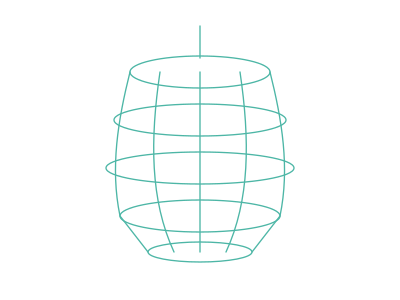
A beautiful mesh is not a printable lamp. We set wall thickness for a 0.4 nozzle — three lines as a floor — and we split large shades into stacked rings or a cap-plus-body. Seam, brim, and orientation are marked in the 3MF. If a wall drops below that floor, the gyroid that looked perfect in the viewport will gap on the farm.

Light has to pass. Too thick and the shade goes dead; too thin and the wall gaps. We keep the lamp-holder out of the problem. The file you download is the wall, the split, and the notes we would give our own farm. Layer lines become part of the drawing.

Coming packs — Grasshopper (.gh) and Rhino (.3dm) — will carry the same constraints, not a raw viewport export. Until those cards unlock, the library ships 3MF and STL. See kinds on the shelf.

03 — Verify and path

Water-bath, then spiral and vase

Water-bath load test photo: water test

We do not test waterproofing. These are dry lamps. The bath is a way to see structure without a lamp-holder in the frame. A thin wall that looks fine in air will show you where it is weak once it takes a gentle load in water. Light through water is also closer to how a shade will glow than a desk lamp pointed at a raw mesh.

If a wall buckles, it does not leave the lab. If it holds, we hang it on a finished lamp from the farm and look again. Print-tested means both steps. That is the difference between a file that sliced and a file we will put on the monthly shelf. Shorter note in the journal.

Spiral and vase toolpaths come after the wall is honest. A continuous path suits a shade that is already a single thin shell. The member slicer — the Studio lobby — is being built around those two paths first. The engine is not live. The constraint is: we will not offer a path the farm has not already run. Open the slicer lobby.